Parking Lot Paving in Lafayette
Call (574) 230-5996 for a free estimate.
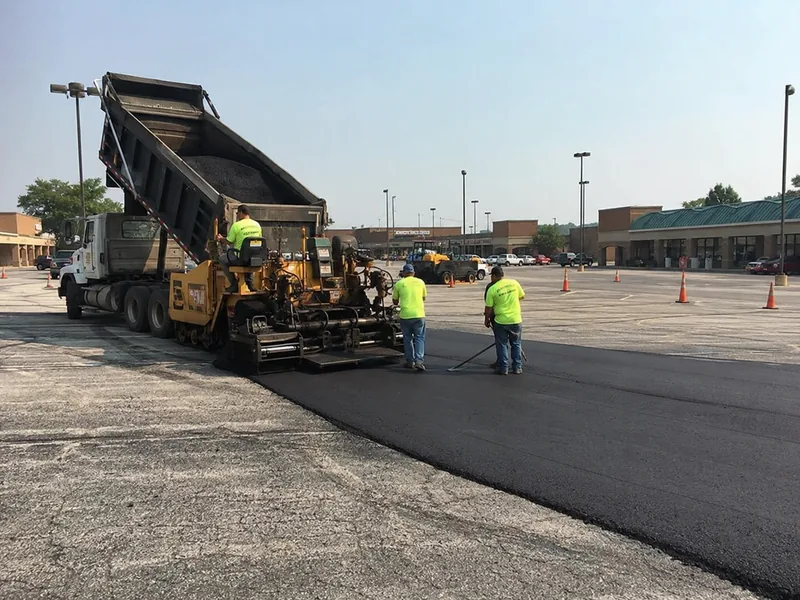
A property manager on Sagamore Parkway called us two springs ago with a lot so far gone her tenants were routing customers around the potholes with cones. Full tear-out was not in the budget. We rebuilt the failed sections, overlaid the rest, and re-striped, and the lot has two winters on it now without a single callback. That is the job in a nutshell: matching the fix to the budget without pretending a band-aid is a rebuild.
We build and maintain lots for retail, offices, medical, churches, restaurants, apartment complexes, and industrial sites across Greater Lafayette. New construction gets engineered sections sized to traffic, a delivery truck lane needs more asphalt than a row of employee stalls, and we design drainage so water leaves the lot instead of ponding at the entrance.
Lot work is scheduling work. We phase projects so part of the lot stays open, work weekends where it matters, and coordinate around your hours. Restaurants get paved on Mondays, not Fridays. Churches get paved any day but Sunday.
ADA compliance rides along with every lot job: accessible stall counts, access aisles, signage, and slope requirements, handled as part of striping rather than an afterthought.
Request a Detailed Estimate
What Commercial Asphalt Costs in the Lafayette Market
Budget numbers for 2026 planning, per square foot: new lot construction on prepared subgrade typically runs $4 to $7, mill-and-overlay of an existing lot $2.50 to $4.50, full-depth reclamation and repave $5 to $8. Sealcoating with crack repair prices around $0.20 to $0.40, and a re-stripe alone is usually a few hundred to a couple thousand dollars depending on stall count. Every serious commercial bid should be broken out by unit: square feet, asphalt tonnage, thickness per course, and mobilization. If a bid gives you one number for the whole lot, you cannot audit it, and someone is counting on that.
A Maintenance Program That Actually Saves Money
Asphalt fails on a curve, not a cliff. For roughly the first 15 years a lot loses condition slowly and cheaply, then the curve turns and every year of neglect gets expensive fast. Industry studies put it memorably: a dollar of preventive maintenance early defers 6 to 10 dollars of rehabilitation later. In practice, for a Lafayette lot, a sensible cycle looks like this:
| Timing | Work | Why |
|---|---|---|
| Every year | Walk-through, crack check, drainage check | Catch water entry while it is a $500 fix |
| Years 2-3, then every 2-3 | Hot rubber crack sealing | Keeps water out of the base, the whole ballgame |
| Every 3-4 years | Sealcoat + re-stripe | UV/salt protection, fresh appearance |
| As needed | Patch failed areas same season | A pothole doubles in repair cost roughly every year it waits |
| Years 15-25 | Mill and overlay | Resets the clock for a fraction of reconstruction |
We run this as a simple reminder program, no contract lock-in: we inspect, send photos and a quote, you approve or skip. Several of our commercial customers have never had a surprise pavement expense since getting on the cycle, and that is the entire pitch.
Liability, ADA, and the Stuff That Gets Property Owners Sued
Pavement is a premises-liability surface. Potholes and heaved sections are trip hazards, poor drainage means ice sheets in January, and accessible-parking violations are low-hanging fruit for drive-by ADA complaints, which are a real cottage industry. Current standards govern how many accessible stalls a lot needs (scaling with size), van-accessible dimensions, access aisle widths, signage height, and maximum slope. We fold compliance checks into every lot job so the fix rides along with work you were doing anyway, always cheaper than the letter from a lawyer.
Asphalt vs Concrete for Lots
Concrete has its places in a commercial site: dumpster pads, where garbage-truck outriggers point-load the surface, loading docks, and sometimes drive approaches. For the field of the lot, asphalt wins on installed cost, repairability, speed (a lot can open 2 to 3 days after paving, concrete wants a week of cure), and winter behavior with salt. Most sites end up hybrid, concrete pads at the abuse points, asphalt everywhere else, and that is usually what we quote.
Frequently Asked Questions
Can you keep our lot open during work?
Yes. We phase nearly every commercial job so customers and staff can always park. A full-closure job exists, but it is rare and we will tell you up front.
How long does a parking lot last?
A well-built lot in this climate runs 20 to 30 years with maintenance, 12 to 15 without it. The difference is almost entirely whether water was kept out of the base.
How often should a parking lot be sealcoated?
Every 3 to 4 years for most lots, with high-traffic drive lanes sometimes on a shorter cycle. Crack sealing should be checked annually, cheap to do, expensive to skip.
Do you work nights or weekends?
Where the business needs it, yes. Retail and restaurant lots often get phased over weekend mornings or a closed day so revenue hours are untouched. Say what hours hurt least and we will schedule around them.
Do you handle ADA striping requirements?
Yes, stall counts, access aisles, signage and slopes per current standards. If your lot predates the current rules we can bring it up to spec during a re-stripe.
Need Parking Lot Paving in Lafayette? Contact us today for honest, affordable prices.
Call (574) 230-5996