Lafayette Driveway Paving
Call (574) 230-5996 for a free estimate.
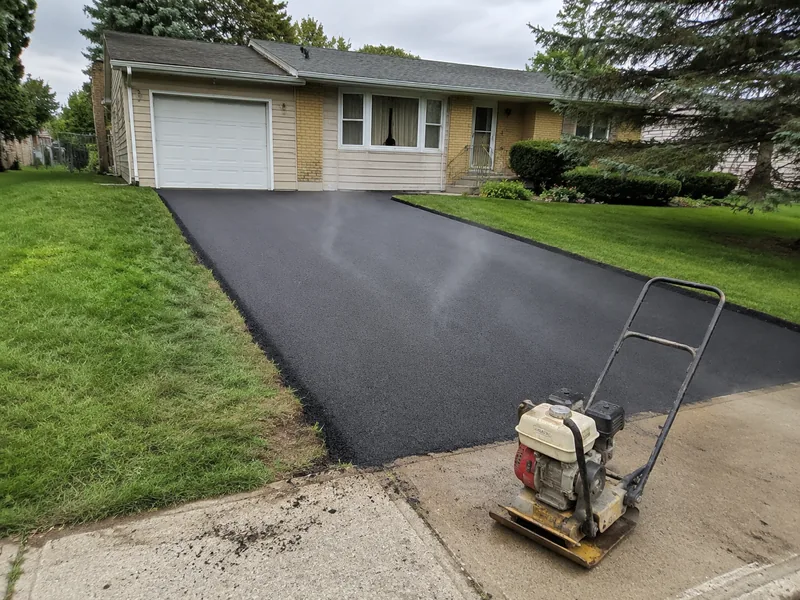
A driveway looks like a simple slab of black. It is actually a structure, and the part that decides whether it lasts 25 years or 5 is the part you never see. When we pave a new driveway in Lafayette we excavate to grade, lay and compact crushed stone in lifts, set the pitch so water runs away from your garage instead of into it, and then pave hot mix at the correct temperature with a machine-laid mat, not a hand-raked guess.
Thickness matters and it is where cheap bids hide. We pave residential driveways at a compacted 3 inches of asphalt over 4 to 6 inches of stone, thicker at the apron if you park a camper or boat trailer on it. The inch-and-a-half driveways the traveling crews roll out look identical the day they are finished. They are not identical in March.
Replacing an old driveway? Tear-out day is oddly satisfying, the whole thing is usually out by lunch. We haul the old asphalt to the recycler, fix whatever the removal reveals underneath, and most two-car driveways are paved by the end of day two. You can walk on it that evening and park on it after three days.
We also do widenings and extensions, turnarounds, and the little pad beside the garage for the third car or the camper. Matching new asphalt to old is mostly about honest edges and a clean saw cut, and after a season of weather the color evens out.
Every driveway quote is written, itemized, and free. It also holds, we do not do the thing where the price grows once the equipment shows up.
Request a Detailed Estimate
What Is a Driveway, Really? The Anatomy Under the Black
Hot mix asphalt, the material itself, is about 95 percent crushed stone and sand held together by roughly 5 percent asphalt binder, a petroleum product that arrives at 300 degrees and hardens as it cools. But the asphalt layer is only the visible third of the structure. A driveway that lasts is three layers working together:
- Subgrade. The native soil, graded and compacted. Around Lafayette that usually means clay, which holds water and moves when it freezes. If the subgrade is soft or wet, nothing built on top of it survives, so problem spots get undercut and filled with stone before anything else happens.
- Aggregate base. Four to six inches of compacted crushed limestone. This layer spreads wheel loads, drains water away from the asphalt above, and gives the pavement its actual strength. When you hear us talk about "base failure," this is the layer that failed, almost always because water got into it.
- Asphalt surface. Three inches of hot mix, compacted by roller while hot. On thicker commercial work this splits into a coarser binder course and a finer surface course, but a residential driveway is typically one well-compacted lift of surface mix.
Compaction is the quiet hero of the whole system. Asphalt leaves the paver at about 80 percent density and the roller works it to 92-plus percent before it cools. Miss that window and the mat stays porous, soaks up water, and ravels apart years early. It is also why a crew that shows up with a paver and no roller is telling you something.
What Does a New Driveway Cost in Lafayette?
Working ranges for 2026: $4 to $8 per square foot for paving over a sound or repairable base, $5 to $10 with full tear-out and disposal of the old surface. A typical two-car driveway of 600 to 900 square feet lands between $3,500 and $7,500 all-in. Long rural drives price lower per foot because mobilization spreads across more tonnage. The full breakdown, including every factor that moves the number, lives in our cost guide.
How to Choose a Driveway Contractor (From a Contractor)
Get every bid in writing, and make sure each one states three numbers: base depth, compacted asphalt thickness, and the warranty period. If a bid just says "pave driveway, $X," you cannot compare it to anything, and that is usually the point of writing it that way.
Ask where the mix comes from. A contractor who names the plant is a contractor who pays his plant bill. Ask who will actually be on site, some outfits sell the job and sub the work. Ask for two addresses from last season you can drive past, pavement that has seen a winter tells the truth. And treat any door-knock offer of "leftover asphalt" as what it is, a documented scam.
Price-wise, the middle of three quotes is usually right. The high bid is often padding, and the low bid is nearly always missing an inch of asphalt or a step of base work you will pay for twice.
What Pave Day Actually Looks Like
Day one, on a replacement job: the old driveway comes out with the skid steer and gets hauled off for recycling (old asphalt is one of the most recycled materials in the country, it becomes part of new mix). We regrade, fix the base, and compact. Day two: trucks bring mix from the plant, the paver lays it in a continuous mat, the crew hand-works the edges, and the roller compacts everything while it is hot. You will smell it, the smell fades in a day or two. By evening you can walk on it. Three days later you can park on it, and about 30 days later it is fully cured, which is when we like driveways best.
New construction adds a step at the front, cutting the drive to grade and building the full base from scratch, and inspection of any culvert or drainage the driveway crosses. Either way, most homes are done inside two working days, weather permitting, and "weather permitting" is real: hot mix cannot go down on a wet base or in the rain, so a rainy week can slide the schedule. When that happens, we call. Nobody likes the reschedule call, but it beats pavement rolled over standing water.
Frequently Asked Questions
How long does a new driveway take?
Most residential driveways take one to two days: demo and base work the first day, paving the second. Weather can stretch that, hot mix does not go down in rain.
How thick should an asphalt driveway be?
Three inches compacted, over a proper stone base, for a standard residential driveway in this climate. Heavier vehicles justify more. If a bid does not state compacted thickness in writing, ask why.
Can you pave over my old driveway instead of replacing it?
Sometimes, and it saves real money when the old surface is structurally sound. That is called an overlay, see our resurfacing page. If the base has failed, though, an overlay just prints the old cracks through the new surface within a couple of years, so we check first.
Asphalt or concrete for a driveway in Indiana?
Asphalt costs roughly a third to half less installed, handles freeze-thaw movement better, tolerates road salt, and repairs invisibly. Concrete lasts longer between major work and stays cooler in summer, but a concrete repair never matches and salt spalls it. In this climate, on cost per year of service, asphalt usually wins, which is why most driveways here are black.
What warranty do you offer?
One year workmanship on new paving, in writing on the quote. Frankly, workmanship problems show up in the first freeze-thaw winter or not at all, which is exactly what the warranty is for.
When can I drive on it?
Walk on it after 24 hours, drive on it after about 3 days, and give it a month before parking trailers or turning the wheel while stopped.
Need Driveway Paving in Lafayette? Contact us today for honest, affordable prices.
Call (574) 230-5996