Farm and Agricultural Paving
Call (574) 230-5996 for a free estimate.
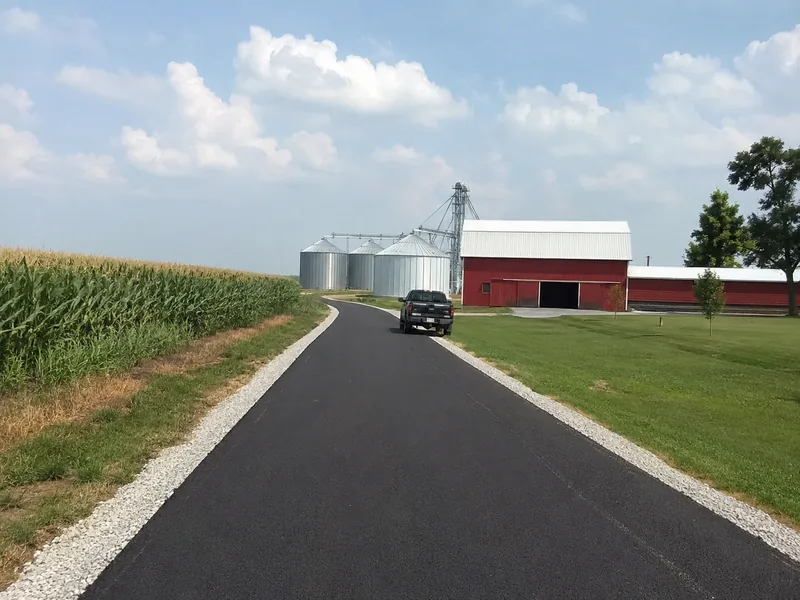
A loaded grain truck at harvest can push 80,000 pounds. A driveway built for cars simply dies under that, which is why farm paving is its own discipline and why we treat it that way. Tippecanoe, Clinton, White and Carroll counties are corn and bean country, and we have paved lanes, aprons and pads on working farms across all four.
Timing is planned around your calendar, not ours. Nobody paves a grain lane in October. We book farm work for late spring and summer, after planting and well clear of harvest, and we design the drainage first because a farm lane that ponds is a farm lane that heaves.
Several of our farm customers started with one apron and called back for the lane the next season, which is the pattern we are happiest to see.
Get Your Free Estimate
Why Farm Pavement Is Engineered Differently
Pavement engineers measure traffic in equivalent single axle loads, and the arithmetic is brutal: damage rises roughly with the fourth power of axle weight, so one loaded semi does the structural damage of several thousand passenger cars. A farm lane that sees grain trucks for two weeks a year lives a harder life than a suburban cul-de-sac does in a decade. Our farm sections reflect that: 4 or more inches of asphalt, often in two lifts, over 6 to 8 inches of compacted stone, with geotextile fabric under the base where the subgrade is soft, and wider, thickened edges where trailers track off-center. Quoting a farm lane at residential spec is cheaper and we do not do it, because we would rather explain the price once than the ruts every fall.
The Surfaces a Working Farm Actually Paves
Grain bin pads want dead-flat, sweepable surface so augers sit true and spilled grain does not mix with stone, and a paved pad ends the gravel-in-the-grain problem for good. Barn and shop aprons take the pivot-scrub of skid steers and loaders, that is a thicker surface course and tight compaction. Equipment yards get sized for the heaviest thing you own, tell us the sprayer's loaded weight, not its brochure weight. Feed alleys, scale approaches, and the lane itself round out the usual list. We have also paved the odd basketball half-court next to the shop, farm kids negotiate hard.
The Business Case, in Farm Terms
Against gravel, asphalt saves the annual stone load and the box-blade hours, keeps wash-outs from eating the lane every wet spring, and lets you plow snow at full speed with a steel edge instead of tiptoeing. Against concrete, asphalt installs at roughly half to two-thirds the cost over big areas, tolerates ground movement without cracking through panels, and patches invisibly when the inevitable happens. Concrete keeps its advantage at feed bunks and anywhere silage acids sit, asphalt binder is a petroleum product and constant oil or silage-leachate exposure softens it. Most farms end up with concrete at those two or three abuse points and asphalt across everything else, and that mixed layout is usually exactly what we quote.
Booking Around the Crop Calendar
Farm paving happens in the window after planting settles and well before harvest, practically, June through August around here. That window fills first of anything on our schedule, so winter and early-spring calls get the pick of dates. Weather slack is built into every farm booking, and if the agronomist says spray day is Tuesday, we work around spray day.
Frequently Asked Questions
Is asphalt cheaper than concrete for farm surfaces?
Usually, yes, meaningfully so on big areas, and asphalt tolerates ground movement better. Concrete still wins for a few specific uses like feed bunks. We will tell you which is right per surface.
Can you pave around our harvest schedule?
That is the only way we do it. Farm jobs get booked for late spring and summer windows, and we build in slack for weather.
How thick does a grain-truck lane need to be?
Four inches of asphalt or more over 6 to 8 inches of compacted stone is our usual working spec, adjusted for soils and loads. Heavier than residential, priced accordingly, and it is the difference between a lane and an annual repair project.
Need Farm and Agricultural Paving in Lafayette? Contact us today for honest, affordable prices.
Call (574) 230-5996